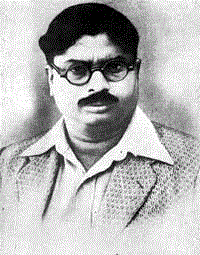
couple of days ago, I found out that there was a N G Majumdar Memorial Point on the banks of Nai Gaj in the Dadu district in Sind, Pakistan; not only that, there was a N G Majumdar Memorial Café by its side. The Google Maps coordinates of these points were also sent:
N G Majumdar Memorial Point
https://maps.app.goo.gl/1SFM4dWm7abVqzUQ9
N G Majumdar Memorial Point Café
https://maps.app.goo.gl/xNR17MJUURsnufpJ8
How did this happen? What we can gather is that, about ten years ago, on January 16, 2011, the newspaper Dawn carried the following report:
A ceremony was held on Sunday to pay tribute to renowned archaeologist Nani Gopal Majumdar at Rohel Ji Kund where he had been killed by a robber while he was doing excavation work in the Kachho area on Nov 11, 1938. A plaque was installed at the place.
On January 17, 2011, there was a further report/letter which read as follows referring to the previous day’s ceremony:
On Jan 16 Kacho Exploration, Anees Academy and Sujag Sansar, Johi, remembered him after 73 years by inscribing words of gratitude on the signboard.
These words are: ‘Sindh would remember you for centuries, and your work would be a guiding principle for those who are interested in archaeology of Sindh’.
The board is erected, where he was murdered.
This initiative by some individuals invites Sindh University, Jamshoro, and Shah Abdul Latif University, Khairpur Mirs, and Karachi Univerity to award posthumous honorary degree of doctorate in literature to N.G. Majumdar, who is still a source of inspiration for explorers, especially who are interested in archaeology.
Slightly before these reports appeared, Professor Dipankar Dasgupta had written an eulogy about his teacher Tapas Majumdar in the Telegraph (Kolkata, October 19, 2010) wherein among other things, he had mentioned the fact that Tapas Majumdar was the son of the famous archaeologist Nani Gopal Majumdar. This was picked up by the Sindhi scholar Professor Aziz Kingrani, who wrote to Professor Dasgupta asking for the details re Nani Gopal Majumdar and Professor Dipankar Dasgupta put him in touch with me. I should perhaps clarify that I am the son of Nani Gopal Majumdar’s older daughter. While we were grieving for Professor Tapas Majumdar, we put together details re Nani Gopal Majumdar and sent it across. Presumably these details were used by Professor Kingrani in his letter in the Dawn on January 31, 2011 where he first corrected the biographical inaccuracies which had crept into the earlier Dawn reports and made the further clear suggestion:
“It is suggested that the department of archaeology and the government of Sindh should build a cenotaph at the place where he was assassinated to pay tribute to the archaeologist from Bengal”.
Recently I had written to Professor Kingrani, with an enquiry whether the cenotaph had indeed been set up. After all, many such suggestions are often made, but not many get carried out. Imagine our surprise when we learnt what had been done together with their position on Google Maps!
While we were wondering how come now? And many asked me how I came to know about this, since there had been no other communication, I thought I would explain the above in brief. Some of us also felt that we should take this opportunity to acquaint people of the recent events in Sind and also describe and appreciate the accomplishments of Nani Gopal Majumdar (NGM).
First of all, and this is crucial for an understanding of what took place in 1938, when NGM was killed, he was yet to complete 41. He was killed on 11/11/38; he would have been 41 on 1/12/38, just a few days later. We have a post-card, written to his father-in-law, a Professor of Sanskrit in a Government College in Sylhet; the letter written in a great hurry saying all is well, is like countless letters written by people to their father-in-law; and he said he would be back by December 24! The letter is dated 7/11/38 and that is the last mail from Nani Gopal Majumdar that we know of.
Apparently while engrossed with his work with his team, what they did not know, was that enquiries were being made about them (Statesman, Amrita Bazaar Patrika 18/11/38) from their camel drivers and porters; one of the news reports says that the latter could not pronounce the word archaeology and answered that it was a treasury department set of people; it was also reported that the people made queries about khazane (treasures) that had been dug out. The firing into the camp started in the morning of 11/11/38; some people of the group got bullet injuries; NGM rushed out, saying that these persons are mistaken and to tell the bandits to stop and was immediately hit. His colleagues were more circumspect, staying inside the tents; they came out when the bandits came down from the hills and surrounded the tents. By then, NGM had breathed his last; his colleagues masqueraded being ‘Mussalmans’ by reciting the Kalma which a loyal peon recited at the top of his voice allowing others to follow, and so saved their skins. The bandits looted the tents, captured the five camels and left. The chilling details of this event are from Krishan Deva’s piece “My Last few hours with N G Majumdar” in the Explorations In Art and Archaeology of South Asia, Essays Dedicated to N. G. Majumdar, Editor Debala Mitra (Explorations volume, hereafter).
Among the survivors of the attack, was Krishna Deva, who was to be later elevated to the rank of Director of Archaeology, who by his own account had been training under N. G. Majumdar. What is clear is that no one came to NGM in his hour of need. Maybe their own lives were at stake, and should be forgiven.
There was talk of the huge loss to Bengal’s archaeology immediately after the murder; important people held conferences at various prestigious places. The Calcutta Museum was closed for a day as a mark of respect. The dacoits were ultimately caught, 11 of them and in court said they did not know that it was the tent of a learned person. One account said that the owner of two of the camels which were captured, with a Koran in hand, tracked down the bandits and got back his two camels which were essential for his livelihood. What happened to the remaining three camels is unclear.
There was a report of Government being held responsible for this tragic loss; even that there should have been guards provided. There was mention that compensation was being carefully considered. My grandmother was clear, she considered the Government of the time guilty, and in anger and distress she said that she did not want to touch the compensation provided: Rs 100 per child and Rs 600 for herself. This is the best recollection that NGM’s daughter-in-law has of the amounts; she was told these details by her mother-in-law, my grandmother. How can these amounts compensate for the loss of the bread winner? My grandmother’s parents were fortunately, still quite active and took on the caretaking of the family; her mother Kiran Bala was a tough lady, ready for whatever challenge that came her way. The first thing she insisted was that my grandmother resume her studies; at the time she was widowed, she was just a matriculate, some one who had just finished school. She began studying once more and she and her daughter, my mother, graduated the same year together.
What needs to be noted is not only the amount of work that he accomplished but also its quality and impact. Professor Gregory Possehl of the University of Pennsylvania, wrote in the Explorations volume, “N. G. Majumdar was one of the great archaeologists to have been a part of the early history of research on the Indus Civilisation. His excavations at Jhukar, Amri, Chanhu-daro and many other places were seminal contributions to the understanding of the culture history of early Sind. …”. A more explicit appreciation of the quality of NGM’s work is made by Professor Louis Flam of the Department of Anthropology, Lehman College, CUNY, New York. Writing in the Explorations volume too, he points out that NGM had been involved in excavation in Mohenjodaro since 1925 and in “1927-28 received a small grant to excavate at the site of Jhukar which was only 27 km (as the crow flies) from Mohenjodaro”. Here NGM established evidence of not only the same culture as found in Mohenjodaro, the so called ‘Indus culture’ but also a late Indus culture, which Majumdar called the ‘Jhukar culture’; Majumdar applied for a grant to excavate the Indus River floodplain level of the Sindh. Encouraged by the success of his proposal, by 1930, Majumdar had discovered the sites of Amri, Chanhu daro and others. The discovery of Amri was his holy grail that he had sought tirelessly, and his son, describes his evident satisfaction in the Explorations volume. For Amri commeted Professor Flam, “revealed an occupation which was pre-Indus occupation which Majumdar called the Amri Culture”. The choice of which place to dig, according to those involved in excavation work, was made very difficult first because there were so many mounds in the sandy plains and secondly there was hardly any technology to see what lay beneath. It could only be done by systematic analysis of data and correct inference therefrom. Still there were many days that NGM did not find anything at all. One must also read the appreciation of Krishna Deva who, in an essay in the Explorations Volume, describes how he learnt from NGM how to go about searching for the past. Krishna Deva writes “ Majumdar thus presented as comprehensive a picture of Chalcolithic Sind as was possible with the evidence he collected and interpreted, certainly with keen observation and a highly analytical mind. He realised the far-reaching implications of his discovery of Amri and its bearing on the wider question of the relationship between Chalcolithic cultures of Iran, Seistan, Baluchistan and the Indus Valley”. He goes on to quote extensively from Majumdar’s Explorations in Sind to support the above. In a rather poignant passage, Krishna Deva noted that “Majumdar resumed his Explorations in Sind after a gap of 7 years in 1938 and surveyed the foothills of the Kirthar Range…That he exercised great forethought in planning his survey is indicated by the fact that he discovered in a short space of three weeks some half a dozen Chalcolithic sites including the site of Rohel-jo-kund where he was killed…”.
A complete listing of the publications of NGM (due to Mallar Mitra in the Explorations volume) is made up of 5 books and several articles Among the five books the most well known are the Inscriptions of Bengal Volume III (Volumes I and II were yet to be written) and the Explorations in Sind, Being a Report on the exploratory survey carried out in the Sind during 1927-28,1929-30 and 1930-31, Memoirs of Archaeological Survey of India No 48 and the two part Guide to the Sculptures in the Indian Museum. There are some 65 items listed in the section on Articles, divided into several sections:
- Archaeology: Excavation, Exploration and Conservation
- Epigraphy
- Numismatics
- Art and Iconography
- Museum Notes and the usual residual,
- Miscellaneous
Each of the above section has multiple entries. In any full working life, the above would be the sign of an outstanding scholar; for someone whose life was choked off so early, this is a stupendous record, unlikely to be matched.
The scholars in Sind woke up 73 years after the death of NGM to acknowledge the contribution of this colossus; in India, we have only one volume, the Explorations, mentioned above, to acknowledge the significance of his work. Is this anywhere near adequate, you think?
 Anjan Mukherji
Excellent reading. Thoroughly enjoyed. I am lucky to have you as my teacher. Regards
LikeLike
Excellent piece of information on martyr N.G Majumdar the archeologist to whom province of Sindh should be eternally indebted for cataloging, exploring several archeological sites. I am Sindhi student from province of Sindh, district Dadu and I came to know about this great archeologist and very tragic incident that happened with him by chance as archeology is dull subject for common folks (me being no different). As i was studying the biography of Mr. Sobho gayan chandani a Sindhi communist/socialist leader of British India period who studied at Shantinakitin university in late 1930s established by great Rabindarnath Tagore. He was inquired/ by Tagore sahb about Bengali archeologist N.G Majumdar being killed in Dadu District by Robbers. This aroused my interest into this then anonymous archeologist being killed in Sindh. I feel this unfortunate event in 1930s is bigger loss for Sindh and its archeology than it was for his Family. May our government especially Sindh government awakens from deep slumber and remedies this historical injustice in any form whatever.
LikeLiked by 1 person
Many thanks for this piece of information re Rabindranath’s query re NGM. Today is also NGM’s birthday. It was a great loss when NGM was killed. I hope you have a great success in your endeavours.
LikeLike
Further, would it be possible to send us a complete reference to the biography of Mr Sobho Gayan Chandani? And a copy of the page containing the query from Rabindranath re NGM? We are trying to bring out the collected works of NGM and this information you have been kind enough to provide, will be an important piece in our reconstruction of this scholar’s times. We would be grateful for whatever support you can provide.
LikeLike